“Leadership is not about being in charge. It is about taking care of those in your charge.”
– Simon Sinek
The California Redwoods are known to grow massive in size and live to become ancient landmarks. What makes them such longevity and stability? Deep below the surface, their roots intertwine with other trees, forming a network of connection and solidarity. So when the winds come, the Redwoods are strong enough to sustain the threat of destruction. What would be a challenge to one redwood’s existence becomes a matter of unity and strength in numbers. They all support each other. This is what trust looks like on winning teams. Every player has a part and every part matters.
It All Begins with Trust
If you are looking for a shortcut, read this section. Because all team members rely on each other, trust is fundamental. Trust is the basic ingredient of all high-performing teams. Only after trust is established can a culture be built and can strong execution habits be developed.
Every team has a culture. While culture cannot objectively be measured and even clearly described, they can be, to any degree, healthy or unhealthy, productive or unproductive, and even good or bad. Even still, some thrive in certain cultures where others do not. Regardless of individual preference, anyone on a team desires trust. Trust is difference maker in any team culture.
TRUST —> CULTURE —> EXECUTION
Trust, or lack thereof, is the foundation beneath the surface in every single team. Where trust is not present, the team foundation is unstable and weak. Sure, you can win a few games, but you do not create a legacy when the culture is not built on trust. When the there is no trust, the team players hows up for participation points and a pay check, strictly seeking personal benefits and not the welfare of the team. It is amazing that anything gets done in those environments!
When trust is at the center of your team, you have the potential to build a culture that is transformational, one that changes lives and motivates the team to be the best they can be. Their shared WHY is so big that to the team the mission is existential. It must be done! Cultures like that get spoken of for generations. Everyone remembers the ‘96 Bulls. What an excellent team. They built their legacy on trust.
The Leader’s Responsibility
Leaders are also responsible for the performance of the team. There are times when you have the luxury of building your own team and others when you inherit a team and lack the flexibility to create your own. In the latter case, great leaders work within their staffing and talent constraints to optimize team performance. They may not all be all-stars, but together, they could be a really good team.
When Jesus built his team, he did not go to the most esteemed all stars. He found fishermen from very humble backgrounds and even a tax collector, despised by others for their deception and aggressive collections. These guys would not have been yours or my first choice.
I grew up in the 90s, so excuse my example. When I was a kid, I used to love to watch a movie called The Mighty Ducks. The premise was that a former big-time hockey player fell from grace and ended up coaching a team of misfit, inexperienced hockey players. It was tumultuous and the team was disorderly, uncoordinated and unfocused. Of course, by the end of the movie, due to many pep talks and vision casting, practice and training and repetition, the mighty ducks became champions. There are hundreds of similar sports movies with the same journey. The point is, the coach, the parents, the team, they did not have any more talent to recruit. They had to work with the people they had and make them the best team of performers they possibly could. And they did.
I once had taken a new position where I inherited a team that simply did not perform as well as my previous teams, nor did they have the same high standards. They were generally unprofessional, lacked direction in their work and did not understand the criticality of their role in the supply chain department and within the whole organization. I was not given much flexibility to hire new, so I had to work with the talent and personnel that I had.
They were not low performers, but simply did not have the training and standards set for their performance. Their previous management had not given them the opportunity to cross-train and learn about what the rest of the team was working on. Some people had too much work and stayed late. Others did not have enough and left work on time. This situation was not fair to the team, who would be the ongoing daily place of blame for any failure within the organization. I set out to right this wrong. And it was not easy.
Starting with Trust, I followed the Team Building playbook to build a high performing team to better support the business.
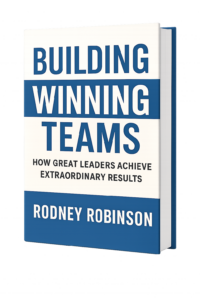
Join the waiting list for my upcoming book on Building Winning Teams.
Receive Your Monday Empowerment
1 Quote, 1 Truth and Action
“Change Your Thoughts and You Change Your World” – Norman Vincent Peale
We could all use a push. The Monday Empowerment Weekly Newsletter is published each Monday morning to motivate you to develop the mindset and habits required to be the best “You.”
Enter your email and sign up for free right now.
Leadership Empowerment